Dosimetry
Radiation Monitoring Policy Statement
The WVU Radiation Safety Committee (RSC) follows the policy that all radiation exposures must be kept As Low As Reasonably Achievable (ALARA).
West Virginia University and WVU Hospitals are committed to meeting the radiation protection standards set by the U.S. Nuclear Regulatory Commission (10 CFR 20) and the West Virginia Radiological Health Program (64 CSR 23).
These limits apply to any radiation exposure beyond normal background levels and medical exposures.
Regulations require that radiation doses from external and internal sources be monitored if a worker could receive more than 10% of the allowed dose limit. When both types of exposure are monitored, the combined total is compared to the annual limit to ensure compliance.
Radiation Dosimeters
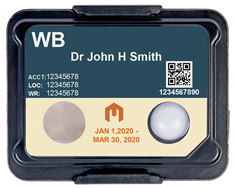
Genesis UltraTM Thermoluminescent Dosimeter (TLD Badge)
External exposure to radiation is monitored by wearing a dosimeter “badge”.
This radiation dosimeter is used for determining deep-dose equivalent radiation exposure to the torso and head from external sources of gamma radiation, x-ray, or beta radiation with maximum energy greater than 0.25 MeV and has a minimum reportable dose of 1 mrem.
Thus, the dosimeter will not record the low energy beta radiation of H-3, C-14 or S-35, because these betas are too weak to penetrate the paper wrapping on the film. However, these betas are too weak to penetrate the outer layer of skin.
The dosimeters we currently use are customized to include the department, user name, wear date, account number, participant number, and serial number.
The whole body dosimeter will be labeled with a WB and the collar dosimeter will be labeled with a CL, and a fetal dosimeter is a blue or white dosimeter and will be labeled with an FET or Fetus.
Ring Dosimeter
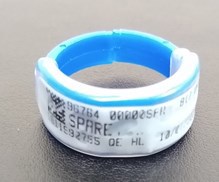
The Ultra RingTM is an extremity dosimeter (ring badge) and is worn on the finger and used to determine shallow dose equivalent from external sources of gamma, x-ray, and beta radiation to the fingers and hands.
The 0.25 MeV cutoff for beta radiation applies here also. The minimum reportable dose is 20 mrem.
Required when handling gamma or high energy emitting isotopes for medical use or if using more than 1 mCi of P-32, I-125, Cr-51, Na-22, Fe-59, Rb-86, Cl-36 for research purposes, or using an open beam x-ray diffraction unit.
Identification is permanently engraved by laser and cannot peel, smear, or wash off. The ring badge is safely encapsulated inside the tamper-resistant cover. The ring is customized to include wear date, account number, participant number, user name and serial number.
Designed with strong hard plastic construction and comes in sizes Small, Medium, Large. Smooth edges allow rings to easily slide and fit inside of disposable gloves.
Wearing The Dosimeters
You may choose to wear your whole-body dosimeter or ring monitor throughout the day, but they must always be worn whenever you are working with radiation sources. This includes radionuclide waste areas and any location where radioactive materials are handled.
Whole-Body Dosimeter: Monitors radiation exposure to your torso and head.
Ring Dosimeter: Wear this on the finger most likely to receive the highest radiation exposure (this may not be your ring finger). The marked side should face your palm, toward the radiation source. Always wear the ring under gloves to prevent contamination when handling radionuclides.
Important Reminders:
Do not place dosimeters in pockets or under your lapel.
Do not take them home.
Store your dosimeter(s) in a safe, radiation-free area when not in use.
Never share dosimeters — always wear your assigned one.
Dosimeters are not waterproof. If one is washed or dried, it must be replaced.
Wearing Single Dosimeter without Protective Lead Apron
Radiation workers with a single dosimeter who are Not wearing a lead apron should wear their dosimeter between the chest and waist.
Wearing Single Dosimeter with Protective Lead Apron
Radiation workers with a single whole body dosimeter who Are wearing a lead apron should wear their dosimeter at the collar of their lead apron or on the thyroid shield, outside of the lead.
Wearing Two Dosimeters with Protective Lead Apron “Double-badge”
Some radiation workers, such as those who perform or assist with fluoroscopic procedures, may receive two dosimeters to monitor potential higher radiation exposure.
Collar Dosimeter (CL): Wear this at the collar of your lead apron or on your thyroid shield, outside the lead. It measures radiation exposure to the head and neck.
Whole-Body Dosimeter (WB): Wear this at your chest or waist, underneath the lead apron. It measures radiation exposure to the body.
The whole-body dosimeter worn under the lead must never be used alone. It should always be paired with the collar dosimeter worn outside the lead.
Using both dosimeters together provides an accurate assessment of your total radiation exposure, accounting for both the protection of the lead apron and the exposure to the head and neck.
The dosimeters must be worn at their specified locations. Accidental exchange of wear location will skew the end calculation of effective dose.
Requesting Dosimeters
It is the responsibility of the Authorized Radiation User to ensure that all occupational workers using radiation under their authorization are provided the required radiation monitoring devices. To request a whole body, collar or ring dosimeter visit the Radiation Safety Department (RSD) web site https://health.wvu.edu/rsafety/forms/. Click on the Badge Application link under Lab/Personnel forms to be taken to the badge application form. This form must be completed before a dosimeter can be issued.
The present policy of the Radiation Safety Department is to issue radiation monitoring devices, after receiving the application to all occupational workers whose job assignments include working directly with radioactive material or radiation producing devices, or to those who are expected to receive a dose in excess of 10% of the applicable dose limits. A ring dosimeter is required when working with quantities of gamma or high energy beta emitting radioactive material of more than 1 mCi or when working with open beam analytical x-ray devices. However, if a person works only with H-3, C-14 or S-35 and is not exposed to any other source of radiation, then this person has no need of a dosimeter.
When an occupational worker is using radioactive materials or radiation producing devices in two separate job assignments or units (e.g. Nuclear Medicine and PET Center) it may be necessary to issue the worker separate dosimeters to wear in each job location. Other individual monitoring devices may be required for monitoring exposures to the eyes or to airborne radioactive material. Contact the RSD for specialized radiation monitoring services.
Upon completing an application requesting a dosimeter, the employee will be asked if they had previously been monitored for radiation exposure at another facility. If they answer yes, that facility will be contacted requesting that individual’s radiation exposure history. In addition, the employee will be asked if they are currently being monitored for radiation exposure at another facility. If they answer yes, the other facility will be contacted requesting that individual’s radiation dose records for the current year. The dose that the individual may be allowed to receive in the current monitoring year will be reduced according to 10 CFR 20.1201(f). If the employee will be working at multiple institutions it is the employee’s responsibility to provide Radiation Safety Department with a Form 5 annually.
Temporary (spare) dosimeters can be obtained from the Radiation Safety Department upon request until the permanent device(s) are received from Mirion (normally 7-14 days). Individuals who have lost their assigned dosimeter should inform the Radiation Safety Department of the lost dosimeter, and they will be given a spare dosimeter to be worn during the rest of the wear period. Spare dosimeters may be requested to be worn by visitors to the facility, if necessary.
Each unit, lab or division is allocated one or more series codes based on their needs and a Coordinator is assigned to administer the distribution and collection of all dosimeters (whole body, collar, fetal, and rings) on either a quarterly or monthly basis, depending on circumstances. Dosimeters should be used beginning on the wear date on the dosimeter or as close to that date as possible.
Return Process
At the end of each wear period, all dosimeters must be sent back to the manufacturer for analysis. Please return your whole-body badges and ring dosimeters to your Unit Coordinator, who will forward them to the Radiation Safety Department for processing.
Be sure to return all dosimeters—used or unused—no later than 15 days after the end of the wear period. Late or missing badges are considered a regulatory violation and can result in disciplinary action.
Timely returns are important because delayed processing can cause a loss of stored radiation data. If a dosimeter is missing, take every effort to locate and return it.
Returning all monitors (whole body, collar, fetal, and rings) also ensures compliance with regulations and allows your unit to receive credit for recycled components.
Unit Coordinators should reuse the original shipping containers to return the dosimeters to the Radiation Safety Department each month or quarter.
Reporting
The Radiation Safety Department receives quarterly exposure reports from Mirion for all Authorized Users and Occupational Radiation Workers. These reports are reviewed by the Radiation Safety Officer (RSO) to confirm that all exposure levels remain within the limits of WVU and WVUH’s Occupational ALARA Program.
Each series code Coordinator receives a copy of these reports to post for review by occupational radiation workers. Explanations and notes about how to read the report are provided on the back of each report.
Please note that it may take several months from the time badges are returned before a report becomes available. Anyone with questions about their exposure results should contact the Radiation Safety Department.
In addition to the monthly or quarterly reports, Mirion also prepares an annual exposure report, which is distributed by the Radiation Safety Department.
Records of all individual monitoring results are maintained in accordance with 10 CFR 20 and 64 CSR 23.
If a dosimeter is lost or missing, the Radiation Safety Department will perform and document a dose evaluation to add to the individual’s exposure record. This evaluation is based on the person’s recent dose history. If no prior data is available, an estimated dose will be calculated using exposure information from other workers performing similar job duties.
Interpreting Radiation Exposure Results
Radiation workers will notice on their dosimetry reports the dates for which the radiation dose was received and radiation doses (in the unit of millirems) for the current monitoring period, quarter to date, year to date, and lifetime to date. The report will have columns for deep, eye, and shall. (shallow) radiation doses. A deep dose (DDE) is the measurement for dose at a tissue depth of 1 cm and applies to whole body exposure. An eye dose (LDE) is the measurement for dose at a tissue depth of 0.3 cm and applies to lens of eye exposure. A shallow dose (SDE) is the measurement of dose at a tissue depth of 0.007 cm and applies to shallow dose of the whole body.
Double-Badge Exposure Results
Radiation workers who wear two dosimeters, one at the collar outside the lead apron and one underneath the lead at the chest or waist, will notice that there is an EDE calculation value in addition to exposure results for each dosimeter. This EDE calculation is the effective dose equivalent and sums the two exposures representing an entire body overall risk. The calculation is 1.5 times the dose reported by the whole body dosimeter, plus 0.04 times the dose reported by the collar dosimeter.
Example:
Whole body dosimeter reading = 50 mrem
Collar dosimeter reading = 1500 mrem
EDE = (50 mrem 1.5) + (1500 mrem 0.04) = 135 mrem
ALARA Compliance
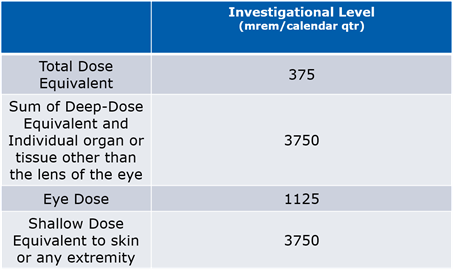
A personalized ALARA memo is generated by Mirion notifying the Radiation Safety Department if an occupational worker’s exposure in that quarter exceeds the ALARA (As Low As Reasonably Achievable) Investigational Level. The memo indicates the exposure and level exceeded and is sent to the RSD to review. According to our “ALARA Program”, the Investigational Level exposure notice is investigated by the RSO to determine the cause of the unusual exposure and may require additional action from the appropriate administrator.
The occupational worker is required to complete a questionnaire and return it to the RSO as part of the investigation. Receiving notification of a radiation exposure exceeding an Investigational Level does not necessarily mean the occupational worker is on pace to meet or exceed annual occupational dose limits. Investigational Levels serve as check points above which the results are considered sufficiently important to justify investigation.
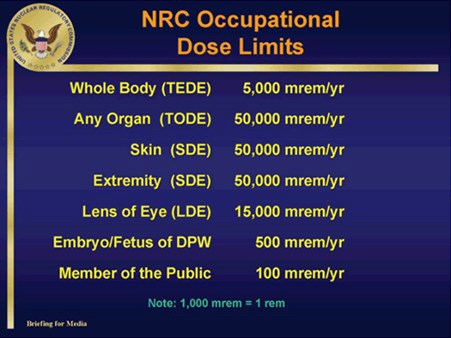
The annual radiation dose limits and WVU ALARA Investigation Levels per calendar quarter are listed in the tables below.
WVU ALARA Investigational Levels
Annual Radiation Dose Limits
Billing
Radiation Safety currently bills the unit, department, or lab using the assigned “Series Codes” quarterly for all radiation monitoring services provided by our dosimeter vendor (Mirion). This includes TLD rings, whole body badges, room monitors, postage & freight, administrative service fees, clips, non-returned monitor fees, unreturned ring badges, annual reports, and various other vendor provided services. Invoices are prepared by Radiation Safety Department and sent out quarterly requesting payment within 30 days in the form of check, credit card, internal transfer or transfer between bank account.
Fetal Radiation Dose Monitoring
A pregnant radiation worker may choose whether or not to formally declare her pregnancy in order to take advantage of lower radiation dose limits for the embryo/fetus.
Declaring a pregnancy is completely voluntary. A worker may choose to declare her pregnancy in writing to her supervisor and/or the Radiation Safety Officer (RSO). If she chooses not to declare her pregnancy, only the standard adult dose limits will apply.
Because the embryo and fetus are more sensitive to radiation, it is recommended that any occupational worker who uses radioactive materials or radiation-producing devices consider notifying their supervisor in writing if they wish to declare their pregnancy. All personal information related to this declaration will be kept strictly confidential.
Once declared, the supervisor should encourage the worker to contact the Radiation Safety Department to discuss potential risks and review ways to minimize exposure during pregnancy.
A monthly fetal dosimeter will then be assigned to monitor radiation exposure to the embryo/fetus.
This dosimeter should be worn at the waist, in addition to the regular dosimeter.
If a lead apron is used, the fetal dosimeter must be worn underneath the apron.
These monitoring procedures and lower dose limits will remain in effect until the declaration is withdrawn—either in writing or verbally—by notifying the Radiation Safety Department. No explanation is required to withdraw the declaration.
For the protection of the embryo/fetus of a declared pregnant worker:
The total dose during pregnancy should be less than 500 mrem (5 mSv).
The monthly dose should be kept below 50 mrem (0.5 mSv) to maintain a uniform exposure rate.
The fetus is most sensitive to radiation during the first three months of pregnancy. Each month, the Radiation Safety Officer (RSO) reviews an exposure report showing both the current month’s fetal dose and the cumulative dose for the pregnancy. These reports are separate from routine dosimetry reports.
Bioassays
Internal radiation exposure is rare, but it can occur if radioactive materials are inhaled, ingested, or absorbed. When this occurs, a bioassay may be necessary to measure the amount of radioactive materials in the body.
The need for a bioassay will depend on the radionuclide used, circumstances under which it is used, the volatility of the substance, and amount of activity involved. Bioassays may involve collection of urine, blood, saliva, or nasal mucus. Thyroid bioassays are completed on individuals who have been exposed to volatile radioiodine using an external detector.
Medical personnel should reference bioassay requirements in chapter 6 of the WVU Radiation Safety Manual for Medical Applications. Those utilizing radiation in a research setting should reference bioassay requirements in chapter 10 of the WVU Radiation Manual for Research Applications.